English forces
The Three MusketeersEnglish forces are the armed power through which England intervenes in the struggle around La Rochelle, linking a French religious stronghold to a wider conflict among England, France, Spain, the German Empire, Lorraine, and the many foreign adventurers drawn to the Protestant cause. Their campaign is at once a military operation and an extension of Duke of Buckingham’s personal rivalry with France: the army and fleet carry national honor, dynastic politics, and private desire across the Channel, but material conditions decide the outcome more decisively than romantic or political ambition.
Strategic and Political Background
The expedition takes shape within the struggle over La Rochelle, the last major refuge left to the French Calvinists after the other fortified cities granted protection under Henry IV had fallen away. The city’s survival made it a focus of religious dissent, civil revolt, and foreign intervention. Its harbor was also the last port in France open to England, so closing it would both destroy the remaining bulwark of Calvinism and sever an important English connection. The conflict therefore exceeded a local siege: it joined French royal centralization to the suppression of Protestant resistance and to the rivalry between England and France. The international character of the crisis is explicit. Spaniards, Englishmen, Italian malcontents, adventurers from many nations, and soldiers of differing religious affiliations gathered under the Protestant standard, forming a loose association whose branches extended across Europe. English forces thus entered a political and military network rather than an isolated battlefield. The movement of troops, ships, intelligence, and alliances across the sea made the siege an early form of international warfare in which the port of La Rochelle carried strategic significance far beyond the city itself.
Landing on the Isle of Ré
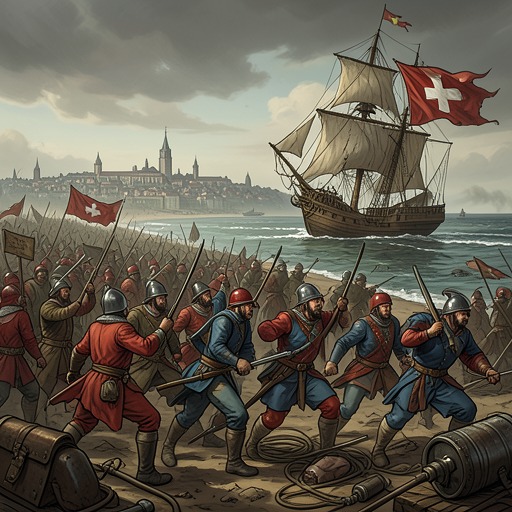
The first major success belonged to English forces. Duke of Buckingham appeared unexpectedly before the Isle of Ré with ninety vessels and nearly twenty thousand men. The scale of the force enabled him to surprise Comte de Toiras, who commanded for Louis XIII, and to secure a landing after a bloody conflict. The English then became masters of the island and pressed the French defenders into the citadel of Saint-Martin and the smaller fort of La Prée, where the garrisons continued to resist. The landing gave Buckingham a substantial operational advantage, but it also revealed the expedition’s double purpose. He claimed to be defending England’s honor, yet he wanted to enter France as a conqueror rather than as an ambassador, and his campaign was connected to his private vengeance. The narrative reduces the immense strategic contest to an intimate political stake: the gesture of Anne of Austria. English forces therefore carry the weight of a kingdom’s military prestige while serving a commander whose motives are inseparable from courtly passion and personal rivalry.
Conditions in the Camp
When d'Artagnan reached the camp before La Rochelle on September 10, 1627, English forces still held the Isle of Ré and continued, without success, to besiege the citadel of Saint-Martin and the fort of La Prée. Hostilities around La Rochelle had already begun near a fort constructed by the Duc d'Angoulême. The English position was threatening, but it was not conclusive: possession of the island had not produced the surrender of its principal French defenses, and the broader siege remained unresolved. The campaign’s decisive weakness was logistical. English soldiers, described as needing good living in order to remain effective, were reduced to salt meat and bad biscuit, while sickness spread through the camp. Rough winter seas destroyed small vessels every day, and the shoreline from L'Aiguillon to the trenches became covered with the wrecks of pinnacles, roberges, and feluccas. These conditions steadily consumed the expedition’s maritime strength and made continued occupation increasingly precarious. Even without a successful French assault, it was becoming evident that Buckingham’s persistence could not indefinitely sustain the siege.
Defeat and Withdrawal
French commanders recognized the moment to act when Comte de Toiras reported that the English were preparing another assault. Louis XIII ordered a decisive engagement rather than allowing the deteriorating English position to continue. The resulting expedition succeeded to the king’s astonishment and to the great glory of Cardinal Richelieu. English forces were beaten in successive encounters and driven back foot by foot, including during the passage of the Isle of Loie. The defeat was severe. The English re-embarked, leaving two thousand men on the field, among them five colonels, three lieutenant colonels, two hundred and fifty captains, and twenty gentlemen of rank. French troops also captured four cannon and sixty flags, which Claude de St. Simon carried to Paris and displayed with ceremony beneath the arches of Notre Dame. Te Deums were sung in the camp and later throughout France, turning the military withdrawal into a public triumph for the French crown and for Richelieu’s political program. With English forces expelled from the island, Richelieu could continue the siege of La Rochelle without an immediate English intervention.
Intelligence, Consequences, and Narrative Significance
The withdrawal did not end the international danger. An envoy of Buckingham named Montague was captured, and evidence emerged of a league among the German Empire, Spain, England, and Lorraine directed against France. Papers recovered from Buckingham’s abandoned lodging confirmed the alliance and, according to Richelieu’s memoirs, compromised Duchesse de Chevreuse and consequently the queen. The English expedition therefore produced consequences beyond its battlefield defeat: its military retreat exposed diplomatic connections that intensified the cardinal’s surveillance and political pressure. English forces also remain tied to the plot through the threat posed by Milady the English spy. Athos states that she has gone to England with the purpose of assassinating, or arranging the assassination of, Duke of Buckingham. The expedition’s failure thus does not dissolve the Anglo-French conflict; it redirects violence from open warfare toward espionage and assassination. Later, when d'Artagnan crosses from France to England, landing at Dover and continuing to London with Planchet, the same Channel that carried the army becomes the route of a clandestine mission. The narrative repeatedly places military power beside private adventure. Buckingham’s fleet and nearly twenty thousand soldiers suggest the overwhelming scale of state action, while Milady’s solitary passage imagines one woman confronting the English preparations with only a few bags of gold. The contrast does not make English forces irrelevant; it shows how armies create the political field in which smaller agents operate. Their landing threatens France, their defeat strengthens Richelieu, their papers reveal a wider alliance, and their presence gives personal vendettas the reach of international policy. English forces are consequently both a historical army and a narrative pressure: formidable in appearance, vulnerable in practice, and ultimately defeated by the combined effects of French resistance, maritime conditions, hunger, illness, and strategic timing.